

Should you buy a GNSS RTK receiver with a laser?
04.07.2026
- Why Do Some GNSS RTK Receivers Include a Laser?
- Meridian M20L vs. E200: What’s the Difference?
- When Does a Built-In Laser Make Sense?
- Does Everyone Need a Laser?
- Reliability and Design Simplicity
- Is the Extra Cost Worth It?
- Which Receiver Should You Choose?
- We’ll Help You Choose the Right GNSS RTK Receiver
Why Do Some GNSS RTK Receivers Include a Laser?
Modern GNSS RTK receivers are no longer defined only by the number of tracking channels, supported satellite constellations, or positioning accuracy. While manufacturers once competed primarily on GNSS performance, today’s innovation is focused on making fieldwork faster, easier, and more efficient.
Features such as IMU tilt compensation have become standard on professional receivers, augmented reality (AR) stakeout is increasingly common, and one of the latest developments is the integration of laser rangefinders directly into GNSS RTK receivers.
So, is a built-in laser worth the extra cost? Or is a traditional RTK receiver all you need?
The answer depends on the type of work you perform, your budget, and how often you would actually benefit from laser-assisted measurements.
Meridian M20L vs. E200: What’s the Difference?
From a technical standpoint, both receivers belong to the same class of modern professional GNSS equipment.
Both models feature:
- 1408 GNSS tracking channels;
- support for GPS, GLONASS, Galileo, BeiDou, QZSS, and IRNSS;
- IMU-based pole tilt compensation;
- compatibility with AR stakeout in supported surveying software;
- a built-in 2 W UHF radio for base and rover operation;
- a rugged magnesium alloy housing;
- drop resistance up to 2 meters onto concrete.
For standard surveying, RTK positioning, and high-precision coordinate measurement, both receivers deliver virtually identical performance.
The key difference is that the Meridian M20L includes a built-in green laser rangefinder with an operating range of up to 100 meters, while the E200 GNSS RTK is a traditional professional GNSS RTK receiver without laser functionality.
When Does a Built-In Laser Make Sense?
A laser significantly expands what’s possible during stakeout operations.
It becomes especially useful when:
- the target point cannot be reached safely or physically;
- the point is located behind a fence or inside restricted property;
- you need to stake out across a ditch, stream, or another obstacle;
- the target lies on a steep slope or other hard-to-access terrain;
- you want to indicate the installation point quickly without placing the survey pole directly on the target.
In real surveying projects, situations like these occur more often than many people expect.
With a laser-equipped receiver, you simply activate laser mode in the surveying software. Instead of calculating coordinates at the bottom of the survey pole, the receiver measures the coordinates of the point where the laser beam is aimed. This allows you to perform measurements or stakeout without physically placing the pole at the desired location.
Does Everyone Need a Laser?
Not necessarily. Professional surveyors have successfully completed projects for decades without integrated laser rangefinders, and many still do today.
If your work primarily involves:
- cadastral surveys;
- topographic mapping;
- control network establishment;
- property boundary surveys;
- precision agriculture;
- most routine construction layout tasks,
then a conventional GNSS RTK receiver already provides everything required for accurate and efficient fieldwork.
In many of these applications, the laser may only be used occasionally—or not at all.
Reliability and Design Simplicity
Another factor worth considering is equipment complexity.
Every additional electronic component—regardless of manufacturer—adds another layer of technology to the receiver. A laser rangefinder includes its own optical system, control electronics, and additional hardware.
This does not mean that a laser-equipped receiver is less reliable. Modern professional surveying equipment is designed and tested for demanding field conditions.
However, from a long-term perspective, a simpler device naturally contains fewer components that could potentially require servicing or repair after years of intensive use. For some professionals, this design simplicity is an important consideration when selecting equipment.
Is the Extra Cost Worth It?
At the time of writing, the price difference between the Meridian M20L and the E200 GNSS RTK is approximately USD 500.
For some surveying companies, this additional investment is easily justified if the laser is used regularly and saves time on complex stakeout projects.
For others, those funds may be better invested in equipment or tools that provide greater value for their specific workflow.
Which Receiver Should You Choose?
There is no universal answer.
The Meridian M20L is an excellent choice for professionals who want access to the latest surveying technologies, frequently work in challenging environments, and expect additional flexibility during stakeout.
The E200 GNSS RTK, on the other hand, offers virtually the same GNSS and RTK performance without the laser module. It is an ideal solution for surveyors who prefer a traditional receiver, appreciate mechanical simplicity, and rarely encounter situations where laser stakeout would provide a meaningful advantage.
Both receivers deliver centimeter-level positioning accuracy, support all major GNSS constellations, include IMU tilt compensation, and provide professional RTK performance.
Ultimately, the decision is not about positioning accuracy—it is about functionality.
If a built-in laser will genuinely improve your daily workflow, the additional investment can easily pay for itself. If most of your projects follow conventional surveying methods, a traditional GNSS RTK receiver remains an excellent professional tool for years to come.
We’ll Help You Choose the Right GNSS RTK Receiver
Investing in a GNSS RTK equipment is a long-term decision. That’s why it’s important to consider not only technical specifications, but also the type of work you perform, your operating conditions, and your budget.
Our team can help you select the receiver that best fits your needs—whether that’s a traditional GNSS RTK receiver or a model with an integrated laser rangefinder. We supply modern professional GNSS RTK equipment, assist with setup and commissioning, and provide ongoing technical support long after the purchase.
Our goal isn’t to sell the most expensive receiver—it’s to help you choose the one that will deliver the greatest value for your work.
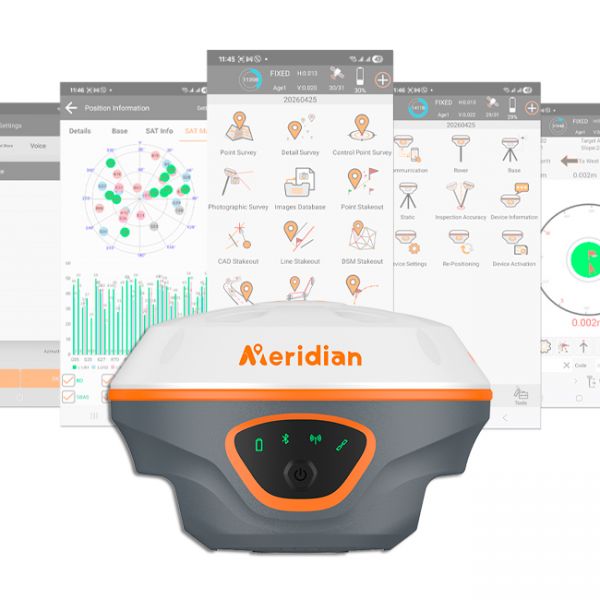
Meridian M20L is a modern next-generation GNSS RTK receiver that combines high-precision GNSS RTK measurements, advanced laser technology, IMU tilt compensation, and an integrated 4G modem for fast and stable field operation. An ideal solution for surveying, cadastral work, construction, and professional mapping.

The eSurvey E200 is a high-performance network receiver with tilt compensation (IMU). It features an upgraded GNSS module with 1408 channels to boost your productivity and exceed expectations. This GNSS rover connects both to GNSS correction networks via built-in 4G and through radio communication. It supports multiple frequencies from different satellite constellations, ensuring enhanced positioning accuracy.